Dear Frontier buyers,
If you only read the headlines in 2025, you might have concluded that carbon removal was stalling. Between declining venture funding and emerging policy headwinds in the US, the macro narrative has cooled. Progress on the ground tells a different story. For Frontier and the companies we support, the past year was marked by relentless, heads-down execution. While the ‘Cambrian explosion’ of early-stage concepts is settling, a focused cohort of companies is moving rapidly towards commercial-scale deployment.
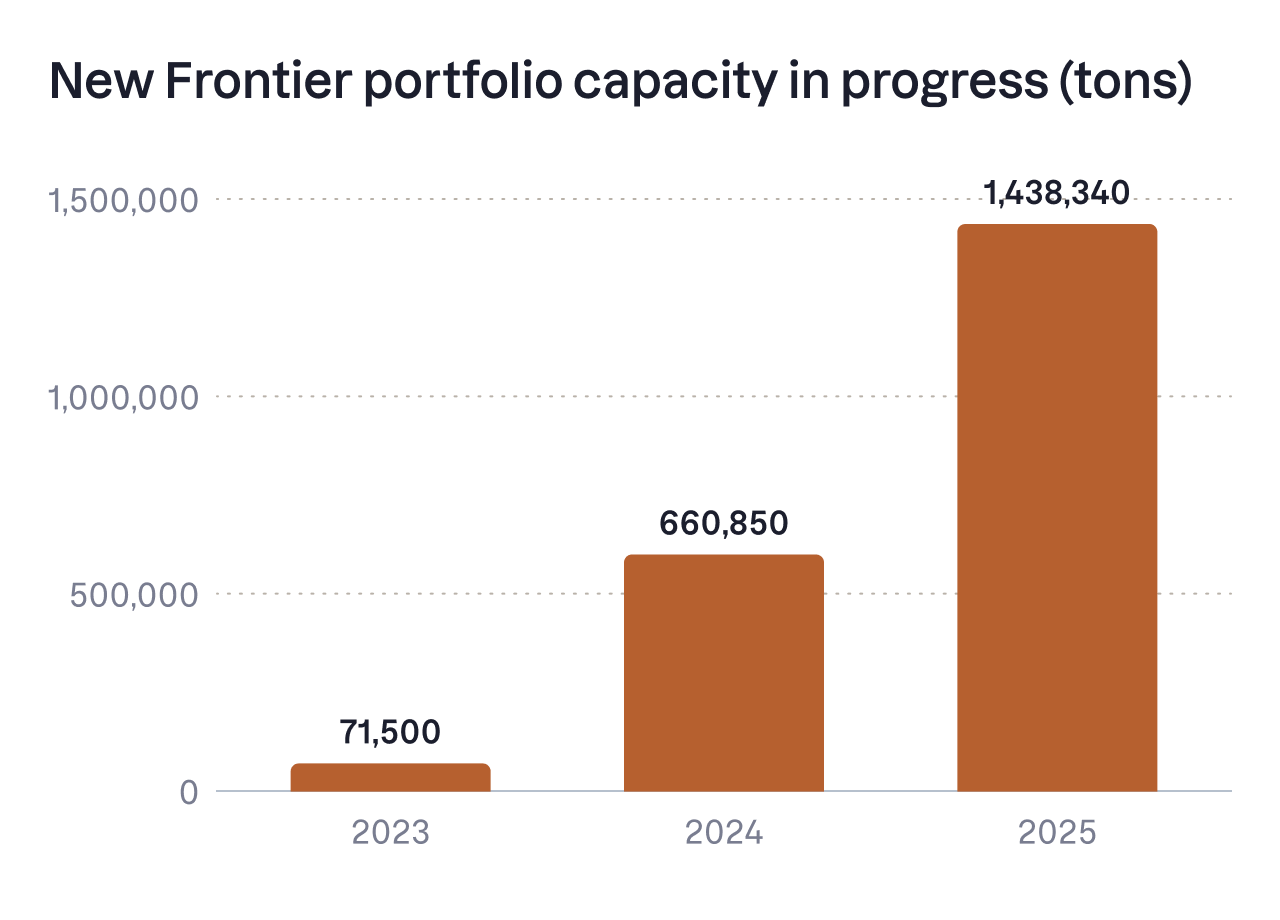
A useful indicator of this year’s progress is new capacity underway. Frontier portfolio companies broke ground on physical infrastructure capable of removing an additional 1.4 million tons of CO₂ a year, more than doubling the capacity that started getting built in 2024. Here’s what else happened in 2025 at Frontier, and how we’re thinking about the year ahead.
Deals
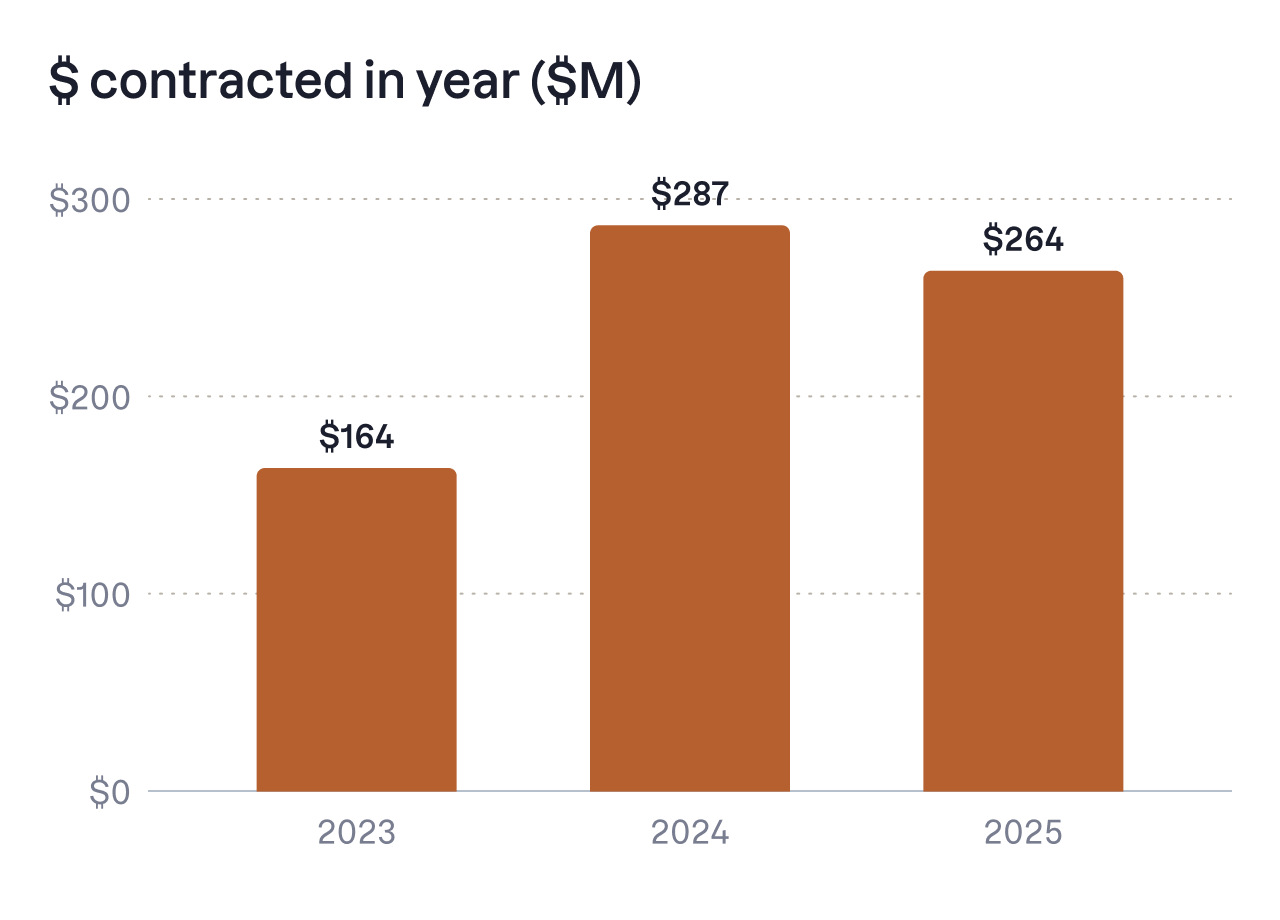
Frontier buyers contracted another $264M worth of carbon removal, $254M of which was in offtakes. Frontier facilitated seven offtakes, across which we saw one of the world’s first commercial deals in ocean alkalinity enhancement (Planetary), an enhanced rock weathering project to deploy olivine, a fast-weathering feedstock (Eion), an electrochemical and energy-flexible approach to direct air capture (Phlair), and a set of diverse biomass-based carbon removal approaches that unlock the best use of waste biomass around the world (Arbor, Hafslund Celsio, NULIFE, Reverion). Frontier was the first offtaker for five of these seven companies.
In addition to facilitating these seven offtake deals, we made seven prepurchases to support innovation across pathways. These purchases covered new and high-potential approaches in surficial mineralization (Karbonetiq), ocean alkalinity enhancement (Limenet, pHathom, PRONOE), electric calcination (Leilac, SaltX), and in-situ mineralization (Cella).
Deliveries
The metric that ultimately matters is deliveries: tons of CO₂ permanently removed. On a relative basis, 2025 was a great year: Frontier portfolio companies delivered 2.3X the volume relative to 2024. And, we saw deliveries across multiple major pathways: ocean alkalinity enhancement, biomass carbon removal and storage, and enhanced weathering.
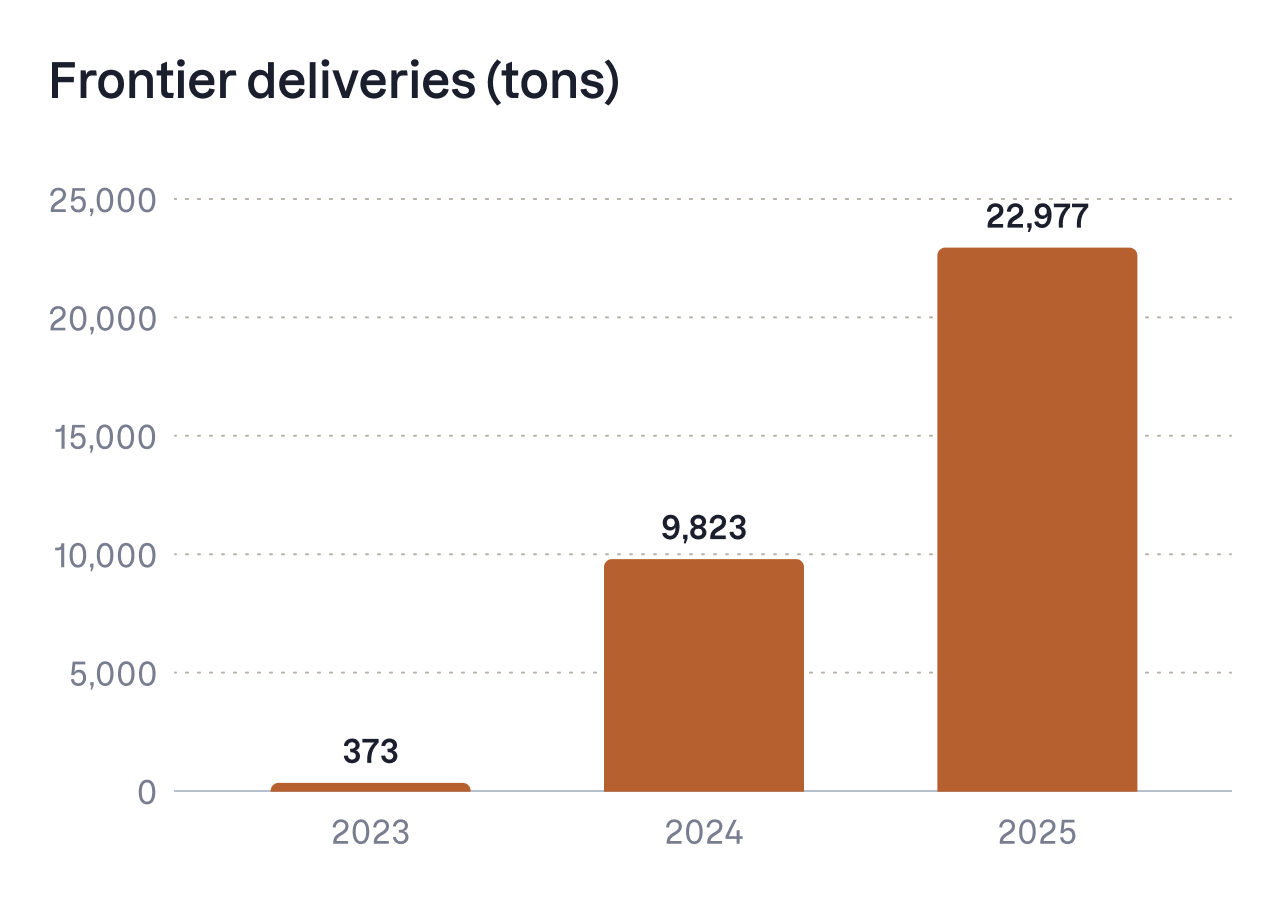
Still, absolute volumes remain small. This year, many companies faced expected delivery delays or fell short of their full contractual volumes. This bumpiness is to be expected: building and operating first-of-a-kind infrastructure is hard. Delivery challenges took many forms, including delays in registry verification, issues maintaining hardware performance while scaling up, and long wait times for CO₂ storage to come online. Companies demonstrated real creativity, patience, and resilience as they navigated these hurdles throughout the year.
Capacity
A leading indicator of future deliveries is capacity. The physical infrastructure being built today determines tomorrow’s delivery volumes. In 2024, our portfolio companies broke ground on infrastructure that will be able to generate around 600,000 tons of removal a year once it is complete. In 2025, that number more than doubled: the Frontier portfolio started building an additional 1.4M tons of annual carbon removal capacity. For example, Stockholm Exergi broke ground on the world’s largest bioenergy carbon capture retrofits; Planetary transitioned from a pilot to continuous, real-world deployment of ocean alkalinity enhancement; and Terradot applied tens of thousands of tons of rock that has already started weathering. Once complete in the coming years, this capacity will translate into a 62X increase in carbon removal deliveries relative to 2025.
Rocks
We spend a lot of time thinking about what technologies it would take to remove gigatons, if not teratons, of carbon. As well as buying from the best existing companies, we also try to proactively identify the gaps in approaches where the physics is promising, but commercial activity may be lagging. In 2025, we went deep on one notable gap: surficial mineralization.
The concept is deceptively simple: find alkaline rock, grind it up, let it absorb CO₂ from the air, and stack it in a pile. Yet having diligenced more than 500 carbon removal companies since 2022, we’ve seen only a handful of teams working on this. We set out to better understand how big and how cheap this approach to carbon removal can be. Assuming the signals were positive, we would then figure out how to radically accelerate progress. A year in, there are still plenty of things to derisk, but we’re increasingly confident surficial mineralization has a path to deliver hundreds of gigatons of carbon removal at <$80/ton.
Looking ahead
In sum, the technological progress over the last year has been significant. As always, the thing that continues to worry us most is whether demand will keep pace with companies as they scale. Going into 2026, we remain laser focused on helping great companies secure the revenue they need—from private companies and governments—to keep building.
Without early buyers, this progress wouldn’t have been, or be, possible. We’re tremendously thankful for your partnership and excited to keep building the field together in 2026 and beyond.
Best,
Nan Ransohoff & Hannah Bebbington Valori