Frontier has awarded $2.1M in grants to the University of St Andrews, the University of Cambridge, [C]Worthy, and Submarine Scientific on behalf of Stripe, Google, and Shopify, with funding support from ClimateWorks Foundation. These projects address key technical hurdles preventing Ocean Alkalinity Enhancement (OAE) from safely scaling.
OAE is a high-potential solution that has moved from lab to field
OAE increases the ocean's ability to absorb carbon dioxide (CO₂) from the atmosphere by adding alkalinity to surface waters. The additional alkalinity allows the ocean to store more carbon as bicarbonate, a stable dissolved form of carbon. OAE — and in particular approaches that add naturally occurring alkaline minerals — has the potential to remove several billion tons of CO₂ with a credible path to costs of under $100 per ton.
A few years ago, the field was still working to establish whether this process could deliver measurable carbon removal outside the lab. Since then, field trials from Ebb Carbon in Sequim Bay and Woods Hole Oceanographic Institution in the Gulf of Maine have demonstrated that the ocean can take up CO₂ from the atmosphere in response to added alkalinity — and that this process can be controlled and measured.
Now, early deployments have also confirmed that, in well-characterized sites with appropriate safety thresholds and protocols that account for uncertainties, it is possible to confidently measure this carbon removal for commercial buyers. For example, in 2025, Planetary delivered the world's first verified OAE credits under Isometric's protocol for OAE from coastal outfalls.
The question is no longer whether OAE can work, but how to deploy it efficiently and at the scale required for meaningful climate impact.
Technical bottlenecks remain for scaling OAE
Getting OAE to its next phase of deployment requires solving three technical bottlenecks:
Identifying the most scalable, suitable mineral feedstocks. Scaling OAE requires access to a large volume of low-emission alkaline feedstocks. In addition to ongoing innovation around the production of zero-carbon lime, we are also interested in other, non-calcium-based mineral sources of alkalinity that are available at large volumes, can effectively dissolve, and can be produced with low life-cycle emissions.
Adding alkalinity safely and efficiently. Chemical conditions change most rapidly where alkaline material mixes with seawater. This can lead to ecosystem hazards and the unwanted formation of precipitates, which means that some of the added alkalinity can be lost before it removes CO₂. Operators need better ways to predict conditions that lead to precipitation and design discharge strategies that avoid them. This is particularly important for OAE scalability because precipitation risk increases with increased dosing rates.
Finding cheaper and more scalable ways to measure and verify carbon removal. Early OAE deployments have relied on intensive field sampling and computationally expensive models. That level of monitoring is appropriate while the field is building evidence and learning from early projects. But to reach climate-relevant scale, OAE will need to develop robust and scalable Monitoring, Reporting, and Verification (MRV) tools that quantify carbon removal and uncertainty without making projects prohibitively expensive to operate.
The four selected projects each tackle one or more of these challenges and will share their research through open-access deliverables that will help ongoing OAE deployments. These projects also represent the first grants from Frontier's refreshed Innovation Program, launched earlier this year.
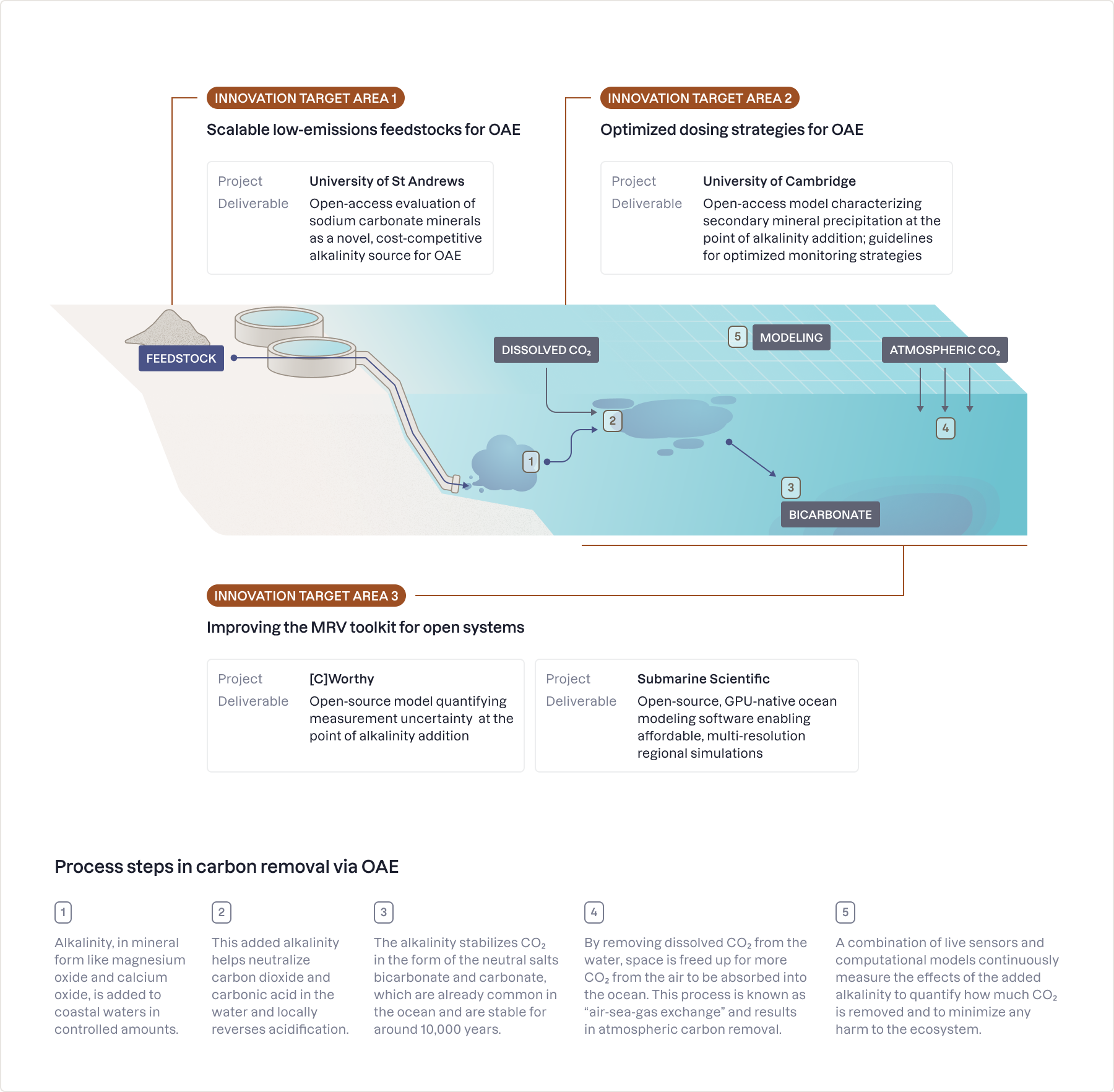 The four selected OAE projects mapped to Frontier’s Innovation Program target areas.
Meet the projects
St Andrews, UK | R&D
A team led by Professor Phil Renforth at the University of St Andrews is studying the feasibility of sodium-based natural minerals as an alternative alkalinity source for OAE. Most OAE approaches today use calcium- and magnesium-based minerals, such as limestone or olivine. Sodium-based alternatives dissolve faster and minimize ecosystem impacts, but their potential for OAE hasn't been fully explored. The team will evaluate whether natural sodium mineral deposits could be a viable and cost-effective feedstock at scale, and will publish an open-access report on the opportunities and risks of this pathway.
Cambridge, UK | R&D
A collaboration between Professor John Taylor and Professor Oscar Branson at the University of Cambridge and Dr. Adam Subhas at Woods Hole Oceanographic Institution is characterizing what happens when alkaline material mixes with seawater near the point of addition. Under certain conditions, unwanted mineral precipitation can occur, which can reduce the carbon removal benefit. The team will identify the fate of these particulate phases and develop strategies to avoid rapid changes in seawater chemistry that may cause unintended environmental impacts. The team will also build models to predict when and how this precipitation occurs, and validate them using OAE field-trial data and targeted lab experiments. Based on the results, this project will develop guidelines to help OAE practitioners design more accurate, lower-cost carbon removal measurement strategies for the critical mixing zone.
Boulder, CO, US | R&D
[C]Worthy is building an open-source OAE modeling tool that will enable researchers and project developers to model processes near the point of alkalinity addition with greater confidence, informing site selection and improving MRV. The model will assess how mixing and transport, mineral dissolution, and the formation and re-dissolution of particles affect how much alkalinity remains in seawater - and how certain we can be about those estimates. The team will validate the model against laboratory and field data, and release it publicly as a shared resource.
San Francisco, CA, US | R&D
Submarine Scientific is developing open-source modeling capabilities that will make it faster and more affordable to simulate ocean conditions at multiple scales around potential OAE deployment sites. Today, regional models that simulate how added alkalinity mixes and moves through the ocean are often too computationally expensive to run routinely and efficiently. Submarine Scientific will combine newer, more efficient ocean-modeling software with high-resolution simulations that span from deployment site to the broader region. They will work in collaboration with Professor Patrick Heimbach at UT Austin to better model critical OAE processes and associated uncertainties at multiple spatial scales, which will ultimately support more accurate and cost-effective MRV.