Certain rocks act like sponges—when exposed to air and water, they absorb CO₂ and convert it into stable carbonate minerals, locking it away permanently. In nature, this process takes thousands of years. By grinding these rocks and exposing them to air, we can compress millennia of carbon removal into decades—an approach called surficial mineralization.
In our 2025 annual letter, we shared our hypothesis that surficial mineralization may be able to deliver hundreds of gigatons of carbon removal at costs reaching <$80/ton. The rock feedstock can be found in massive, concentrated deposits, and processing this type of feedstock is something the mining industry already does cheaply at scale.
Despite that promise, the approach is still nascent: how can we design surficial mineralization to produce the cheapest carbon removal? To help find the answer, we're launching the Quebec Surficial Mineralization Hub at Thetford Mines in Canada.
Our hypothesis for surficial mineralization: serpentinite rocks and "megasites"
For the past year, we've been pressure-testing whether surficial mineralization could be very cheap and virtually unlimited in scale. Here's what's driving our optimism:
- The "right" reactive rock exists in large quantities in geographies that are well-suited for doing this at massive scales. Not all rocks react with CO₂. Among those that do, there's a tradeoff between how fast they react and how abundant they are. We needed a rock that scores well enough on both. The most reactive alkaline rocks, like brucite marbles, are scarce. The most abundant alkaline rock types, like basalt, react too slowly in ambient air. Serpentinite has the right balance: it acts as an efficient-enough carbon sponge, and is abundant enough to scale. We've mapped accessible deposits around the world that hold the potential to scale to "teratons" (trillions of tons) of carbon removal.
- Project sites can get very large, taking advantage of economies of scale. Serpentinite deposits are large and geographically concentrated, which means we can build a few surficial mineralization "megasites" rather than thousands of small ones. Individual serpentinite deposits are big enough to support decades of expansion at a single location. Once a site is operational, expanding it would be relatively fast and cheap, allowing us to grow carbon removal capacity and drive down costs from the same site rather than starting from scratch each time.
- Much of the technology needed already exists at scale in the mining industry. While most carbon removal technologies require complex, novel engineering, the feedstock preparation steps in surficial mineralization—crushing and moving rock—are already done in the mining industry, at low cost and enormous scale. Based on our estimates, removing one gigaton of CO₂ annually would require moving about four billion tons of rock a year—assuming 25% of the rock reacts with CO₂. While colossal, this represents only 5% of the material already moved by the global mining industry today.
- This pathway could be very cheap. This combination—the right rock in massive quantities, the simplicity of the approach, economics that reward scale, and an industry that already does major parts of the process—is why we believe surficial mineralization could be one of the cheapest carbon removal pathways, reaching <$80/ton.
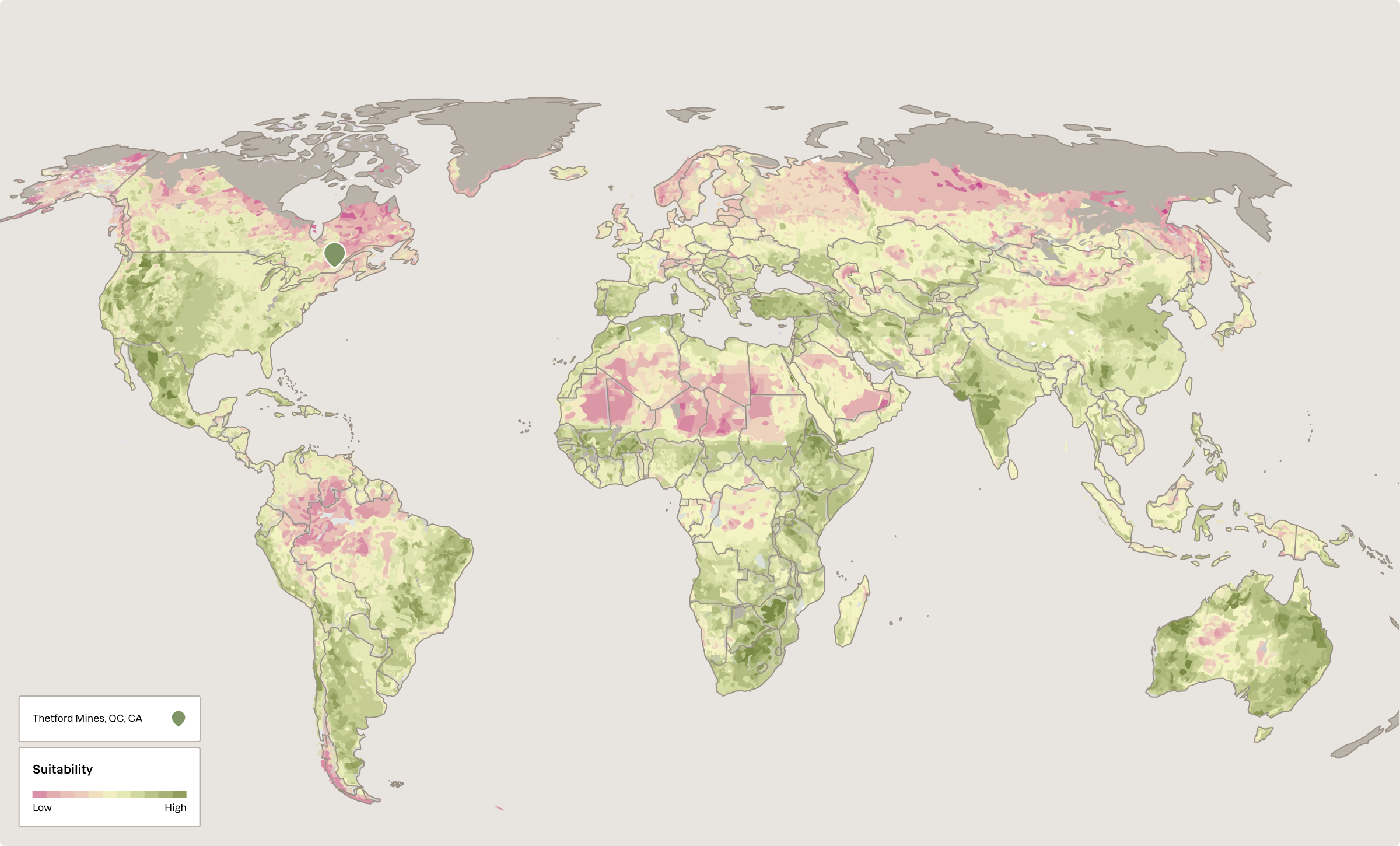 Global suitability of surficial mineralization sites
Risks & open questions
Despite the potential of surficial mineralization, the transition from lab-scale chemistry to industrial-scale deployment hinges on answering a number of open questions:
- We don't yet know which system design will result in the cheapest possible carbon removal. As the rock captures carbon, it builds a carbonate crust that physically shields the rest of the rock from the air. On top of that, simply pushing air through giant piles of rock creates massive pressure drops. Without an efficient "pile architecture", the energy required for fans and blowers will skyrocket, taking the cost right up with it. These are hard engineering problems, but we believe they are solvable.
- There aren't enough teams working on surficial mineralization. Currently, only a handful of specialized teams are figuring out how to make surficial mineralization work in practice—determining the right pile architecture to use, optimizing the reaction, and measuring how much CO₂ is being removed. We need to draw more scientists, engineers, and entrepreneurs into this space.
- High upfront costs could make early projects expensive. Mining operations require significant capital before they produce anything—permitting, environmental review, and heavy equipment. This means buyers will want even more confidence that costs will come down over time.
- Mining-related projects need to meet the highest standards in safety and social license. To reach gigaton scale, we'll have to go from using serpentinite waste, which exists as a byproduct of other processes, to mining serpentinite for the purpose of carbon removal. This shift is impossible without a rigorous, empirical track record of safety. We must demonstrate that serpentinite processing can be done responsibly.
Building a proof-of-concept hub using mine tailings
For early-stage startups, the upfront costs of surficial mineralization—accessing rocks, securing permits, using lab equipment—are prohibitively high. This makes it almost impossible to start a surficial mineralization company. And yet, hundreds of millions of tons of serpentinite have already been mined and are sitting in waste piles at decommissioned asbestos mines around the world.
Quebec holds 800 Mt of serpentinite rock already mined and accessible—one of the largest mined deposits in the world. A large fraction of these tailings sit in Thetford Mines, a region whose economy was historically built on asbestos mining. In partnership with Carbon Removal Canada, we are launching a surficial mineralization hub to accelerate the pace at which we test system designs for surficial mineralization. The hub lowers the barrier to new teams trying new ideas—it will provide:
- Feedstock and site access: 10,000 tons of serpentinite tailings and space for pilot-scale testing.
- Specialized infrastructure: Access to local labs to provide research teams with specialized equipment to develop and demonstrate mineralization processes.
- A controlled testing environment: A site where permitting and social license are already in place, allowing new teams to test new ideas in a safe and controlled manner.
Frontier is now accepting applications for technology teams and researchers with pilot and research projects to turn asbestos waste into carbon removal. If you're interested, learn more about the request for proposal here and apply.