- 44.01's in-situ mineralization (ISM) process turns CO₂ into solid rock underground in a few years, after which the risk of reversal is functionally zero.
- ISM offers a scalable storage pathway in places conventional storage cannot economically reach. Over 50 million tons of industrial emissions could be captured and stored via ISM in the UAE, and globally, similar reactive rock formations could store over 5 billion tons of CO₂ per year through ISM.
- This project is one of the first tests of ISM as a continuous operation rather than a batch pilot. The data it generates will enable commercial-scale expansion.
Frontier buyers have signed offtakes with 44.01, a company that permanently stores CO₂ by turning it into solid rock underground. 44.01's process, called in-situ mineralization (ISM), dissolves CO₂ in water and injects it deep underground into peridotite rock, accelerating a natural reaction with magnesium silicate minerals that locks the CO₂ into stable, solid carbonates. Through this deal, Frontier buyers will pay $11.7 million to remove 20,932 tons of CO₂ between 2028 and 2031. This is Frontier's first ISM offtake.
The offtake is designed to support the demonstration needed to move from successful pilots to commercial-scale deployment. 44.01 has already conducted short-duration injection pilots. The next step is to show that the process can run continuously over multiple years and update cost estimates. By supporting that transition, Frontier buyers are helping generate the operating record that can underpin larger, lower-cost projects and enable 44.01, and ISM more broadly, to expand.
Storage is a major bottleneck for scaling carbon removal that ISM can unlock. A lot of today's durable carbon removal approaches end the same way: with a concentrated stream of captured CO₂ that has to be stored somewhere permanently. Today, that almost always means compressing the CO₂ and injecting it as a supercritical fluid into deep sedimentary basins; an approach that works well where these large projects can be sited, permitted, and operated.
But the best places to capture CO₂ are not always near the best places to store it, and the economics don't always align either. Conventional geologic storage favors large volumes: developing a storage site and building pipelines to reach it requires substantial upfront investment, while permitting can take five to ten years. Smaller, distributed CO₂ sources, such as wastewater treatment plants, biogas upgraders, or small industrial facilities, may produce only tens of thousands of tons of CO₂ a year. At that scale, a pipeline connection or transport chain to a distant storage basin can be too expensive and the permitting timeline too long to make conventional storage practical.
ISM can address both halves of that mismatch by opening up a different set of locations for storage. For example, industrial CO₂ sources near 44.01's existing site in the UAE are within 50 kilometers of well-characterized peridotite rock but more than 300 kilometers from viable conventional storage in the Gulf. Similar opportunities exist in Japan, Oman, Finland, inland Norway, and along the US Pacific coast where reactive rock formations offer storage options in places that have limited access to viable sedimentary basins (see our CO₂ storage map for a visual representation). Where suitable rock is close to a CO₂ source, ISM can reduce the need for long-distance pipelines or shipping infrastructure. Avoiding these high fixed transportation costs can make storage practical for smaller volumes, allowing projects to be sized for the CO₂ available nearby.
Furthermore, post-injection monitoring for ISM is significantly shorter than for conventional geologic storage. The latter requires decades of post-injection monitoring due to the buoyancy of supercritical CO₂. For ISM, the CO₂ isn't going anywhere once it becomes rock, so permanence does not solely rest on caprock integrity with decades of surveillance of a buoyant plume. This results in quicker site closure and liability transfer for ISM.
While ISM offers significant potential to unlock new storage locations, this project will collect the real world technical data to test whether 44.01 can sustain target injection rates over years, how much water the process requires, and what continuous operation costs. Those results will help establish whether the system can support larger, economically viable projects for both carbon removal and industrial decarbonization.
How 44.01 stores CO₂ as rock
44.01 has demonstrated its process in Oman and the UAE on one of the world's largest exposed peridotite formations. Their process is:
- CO₂ is captured and delivered. Biogenic CO₂ is separated during biogas upgrading at a wastewater treatment plant and transported to 44.01's storage site.
- The CO₂ is dissolved in water. At the site, the CO₂ is mixed with water to create a mildly acidic carbonated solution.
- The carbonated water is injected underground. A deviated injection well drilled to ~1,000 meters depth distributes the fluid across a large volume of naturally fractured peridotite — magnesium-rich rock that readily reacts with dissolved CO₂. The fluid is denser than water so it doesn't rise and its movement underground is actively monitored.
- The CO₂ turns into solid rock. The acidic fluid dissolves magnesium and other cations out of the surrounding rock, raising the fluid's pH and causing the dissolved CO₂ to precipitate as a stable carbonate (MgCO₃). Mineralization occurs within 1-3 years, after which the carbon is locked in place for geologic timescales with minimal reversal risk.
- The removal is measured and verified. Mass flow meters at the wellhead track how much CO₂ is injected underground, fluid samples from an adjacent monitoring well confirm the CO₂ is precipitating into rock rather than staying in solution, and geophysical sensors map the fluid underground and continuously monitor for induced seismicity.
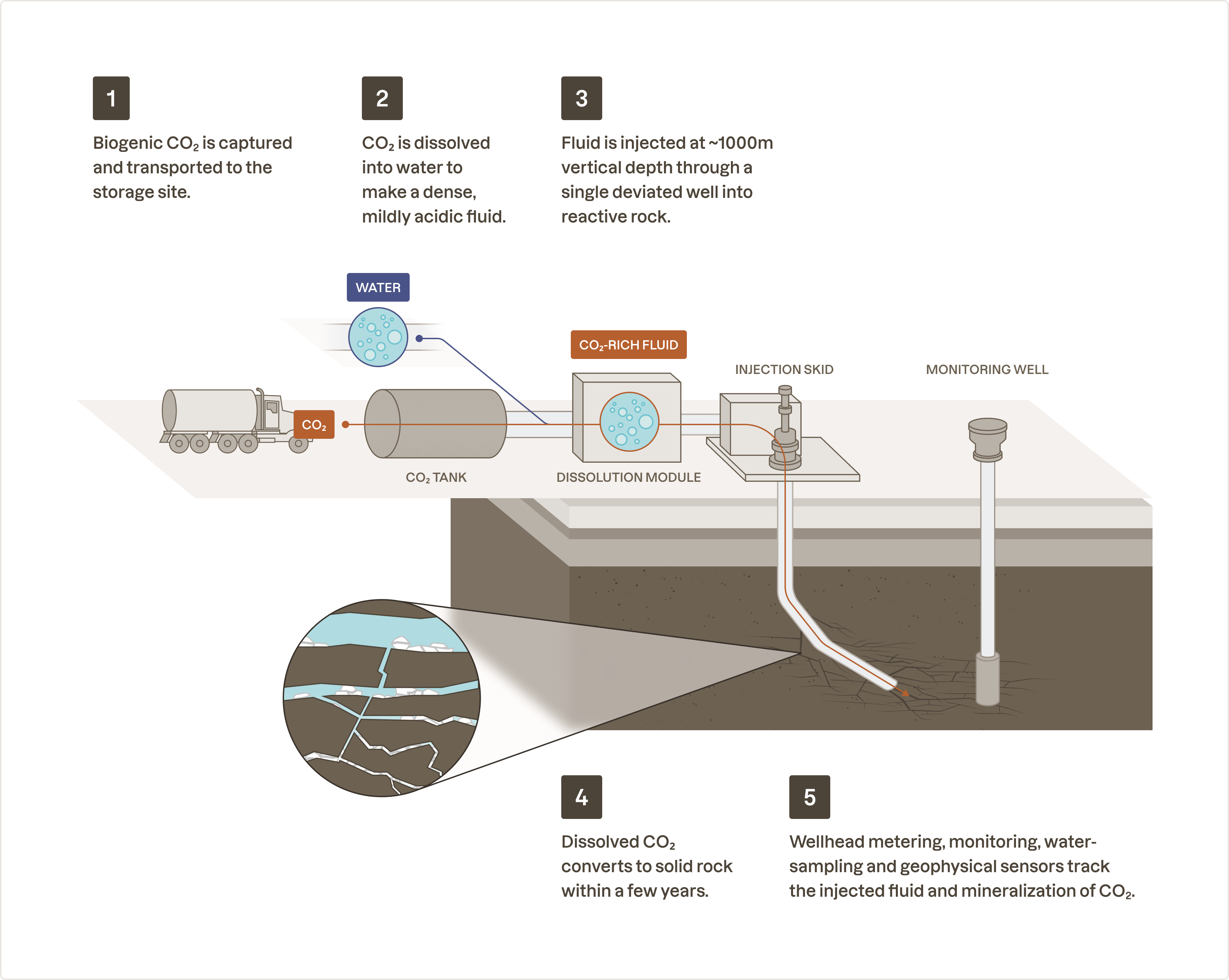 44.01's method of removing and storing CO₂ as solid rock.
The case for 44.01's approach to in-situ mineralization
ISM can accelerate both carbon removal and industrial decarbonization goals. The rock can mineralize any concentrated CO₂ stream, so in addition to carbon removal, these formations can store emissions captured from the cement, steel, and other hard-to-abate industries.
Dissolving the CO₂ before injection adds an additional containment layer before mineralization occurs. The resulting fluid is denser than groundwater, so it sinks rather than rises and is trapped by dissolution before mineralization even begins. Site characterization and geophysical monitoring data have demonstrated that the geological layers above and below the target injection zone act as geological barriers which can provide additional layers of containment.
44.01 has designed its wells to safely improve injection rates and drive down cost. A single deviated well, drilled with techniques borrowed from enhanced geothermal and oil and gas industries, tracks through the naturally fractured rock and exposes the injected fluid to far more reactive rock than a vertical injection point would. 44.01's field trials have demonstrated promising sustained injection rates.
44.01 has extensive ISM operating experience. 44.01 has operated numerous field pilots which have safely conducted short duration CO₂ injection programs since 2023. TÜV SÜD and the XPRIZE Carbon Removal board have done third-party safety reviews.
This project will generate operating data for the broader ISM field. Building on five field pilots, 44.01 will collect multi-year data on sustained injection rates, water use, and operating costs, and share it with the broader community to help other projects evaluate and deploy the approach on a global scale.
Frontier has facilitated purchases on behalf of its Founding Members Stripe, Google, and Shopify, as well as members Autodesk, H&M Group, and Workday. Additionally, Aledade, Canva, SKIMS, Zendesk, Wise, Skyscanner, and Match Group have participated via Watershed's partnership with Frontier.
Talal Hasan, Founder and CEO, 44.01: "This first-of-a-kind agreement with Frontier marks an important step in taking in-situ mineralization from demonstration into commercialization. By turning biogenic CO₂ into rock close to where it's produced, we're making permanent storage accessible to sources that conventional CCS can't reach, opening a new business model for carbon removal and bringing the UAE into the carbon removal ecosystem. Our focus now is on delivering, improving performance and bringing costs down so that more customers can benefit from this technology."
Hannah Bebbington Valori, Head of Frontier: "Where we can store CO₂ shouldn't limit where we can remove it. In-situ mineralization could expand the storage map, making permanent storage practical in places conventional storage can't economically reach. That's why we're purchasing from 44.01: to prove out the technology and ready it for commercial scale."